Haiku

Haiku

Thursday, February 5, 2015

Vientiane: A Soul-less City?

"Vientiane is a city without a heart or soul"

Harsh words from someone I met at my hostel. Anna and I arrived in Vientiane Tuesday afternoon and spent the day wandering around the city. It was not the charming, European-esque, riverside capital city we had imagined. For starters, the Mekong was quiet dried up, so the "riverside" was about 100+ meters from the Riverside Promenade.
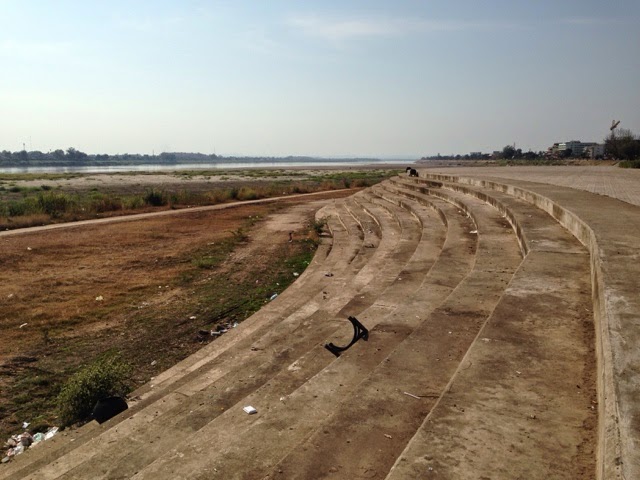

Anna left Wednesday for Myanmar for a 10-day Vipassana course, after which I will meet up with her in Yangon. In the meantime, I am headed to Vietnam! My stay here in Vientiane was a little extended due to waiting on my visa to arrive, which means I will have spent about 3 days here - about 2 days longer than what one should allocate if visitng Vientiane. 

Vientiane itself is not much of a destination but rather a transit point for those traveling in and out of Laos. It's not a pretty city and I left with the feeling that it was a place struggling to build a sense of cultural identity. I have spent my time here wandering the city, learning about Laotian cuisine, and taking the opportunity to catch up on correspondences and emails. These past 36 days have been go, go, go, and you don't realize until you're really alone with your thoughts how exhausting that can be (I'm sure Anna will have more to speak to this after her Vipassana!). I am grateful for this opportunity to slow down, but in a place like Vientiane, I am getting a bit stir-crazy.


The most interesting thing I have experienced here was the COPE Rehabilitation Center (www.copelaos.org). COPE stands for Cooperative Orthotic and Prosthetic Enterprise. Founded in 1997, COPE opened a visitor center in 2008 that aims to increase awareness about disability and highlight the work being done to bring quality care to those with disabilities.

For many of my generation, the Vietnam War (or "American War" as it is known here) is an event of the past, something we've read about in school or seen in movies. Another misconception is that the war affected only Vietnam, but here in Laos the effects of the war are still very real. The map below was made from US Air Force data. Each red dot represents a bombing mission. The number of bombs varied, but over 580,000 US bombing missions were carried out over Laos.


The most terrifying thing? Many of the bombs remain unexploded. While there are efforts around the country to detect and detonate unexploded cluster bombs, this is an issue that affects the lives of the people of Laos everyday.
Some facts below:


So while I wouldn't recommend vientiane as a destination, there is much to learn here. For now, it is time for me to move on and say goodbye to Laos. I'll soon be catching a 24-hour overnight bus to Hue, Vietnam. After a night in Hue I am headed to Hoi An, where I plan on spending a chunk of time before flying out of Hanoi to meet up again with Anna. I have heard stories about tourist transit scams in Vietnam, so fingers crossed this bus ride goes smoothly!


Sunday, February 1, 2015

Viva la Vang Vieng

Last week we decided that it was time to cross borders and adventure into a new country: Laos. We traveled from Pai to Luang Prabang, Laos for two days on the "slow boat" down the Mekong River. This boat journey merits its own post, but I wanted to focus on the present moment of where we've been for the last two days in Vang Vieng, famous as an outdoor adventure hub for tubing, backpacking, rock climbing, biking, and caving.

Given that reputation, I was expecting a down-to-earth Laotian cousin of Telluride, but we could not have been more shocked and a bit appalled when we arrived at night to rows and rows of bars lit up with neon lights, guesthouses, and restaurants playing reruns of Friends and The Simpsons on large flatscreen TVs at all times of the day. Gone were the charming artsy cafes and organic restobars of Pai -- we had been spoiled. Even the street food menus were entirely identical and unappetizing to our veg-loving, MSG-weary bodies:


In the morning, we realized that we were indeed in a stunning area of natural beauty, albeit from the vantage point of a town that seems to have been designed from a teenager's fantasy. I went for a run out of town, crossing a ricketly bridge to the Banana Bungalows, past verdant rice fields, and on to a dirt road notced with rocks and potholes. I followed signs for a cave and tromped through what seemed to be fallow rice fields towards these stunning, steep mountains:


So,  I was feeling much more optimistic about our stay in Vang Vieng once I returned to our hostel. The day only got better and better as we rented mountainbikes to venture along a dirt road out of town to the Blue Lagoon and Tham Phu Kham cave. We relished spectacular views of the steep, bulbous mountains, rice fields, and tranquil village life. Thea waited while some Aussie beefcakes finished flexing for photos on their motorbikes and sped off to capture this stunning contrast of colors:


The Blue Lagoon was overrun with tourists jumping into the water from a thick tree branch overhead, so we continued up to the cave, which had the scale and architectural magnificence of a cathedral:


We carefully hiked 30 - 45 minutes back into the cave, slowly leaving behind the chatter and clatter of other tourists and the bright light of day. We turned our headlamps off at the back recesses of the cave (where we could see no way to proceed) and embraced the strange fear of darkness so complete that it seems to penetrate and rob you of sight forever.

After a quick dip in the Blue Lagoon, we stopped at a restaurant that is part of SAE LAO (www.saelaoproject.com), an NGO aiming to improve and sponsor education for local children and to support more sustainable agricultural practices. Their menu explained that the adverse impacts of tourism on this tiny town, such as destruction of the environment to build more infrastructure and easier access to alcohol and drugs for local youth, motivated the founder Sengeko Frichitthavong to undertake this work. The food was fresh and delicious (a pure fruit shake without condensed milk or glucose syrup!), so we were surprised that the restaurant was empty even though it's only a few minutes from the busy lagoon. It seems most tourists opt for the standard fare sold waterside.

Today we had another magnificent nature adventure. We were scheduled to go rock climbing in the afternoon, but when we arrived at Adam's Climbing School, it turned out that the guides thought we were signed up for the morning half-day and had already left. We decided to explore some caves near Vang Vieng instead. In trying to show Thea a cave that I had found on my run the other morning, I got us lost in a thicket of brambles and burrs, but we ended up on a trail with a few markers of orange cloth tied around trees (like the monk's path to Wat Pha Lat in Chiang Mai). We were accompanied by a flea-infested, but very sweet dog/spirit guide we named "Patches." The path took us straight up a mountainside through boulders and under winding tree branches, but we persisted with the hope that our efforts might pay off in a stunning view. And an hour later, they did:


Vang Vieng seems plagued by the contradictions of stunning natural resources and ready-to-party, let's -drink-while-we-tube-down-the-river tourists. We went to a bar two nights ago that offered free drinks from 9 - 10 pm and balloons filled with laughing gas. A giant crane excavating the earth for more hotel construction blocked yesterday's stunning sunset over the mountains:


On Wednesday I leave Thea to embark on a 10-day silent meditation retreat in Myanmar while she continues on to Vietnam, so this will be my last post for a short while. Happy February and happy full moon to all!

Street Food of Pai

...

Friday, January 30, 2015

A Pai Excursion

"This is a place to linger"

So we were told upon arrival to Pai by our guesthouse companion, Leo (a 30- or 40-something Aussie who has returned to Pai many times over many years). Perhaps "guesthouse" is inaccurate though, "hippie commune" may be more apt. We stayed at Giant Guesthouse, which was slightly outside of the town center. It's comprised of small, basic bungalows along the Pai River, with a central bungalow and communal kitchen. Residents were either transitory travelers like us or people who had come to visit and had been living there for months. We're pretty sure the staff was completely stoned everytime we interacted with them and flyers for dreamcatcher-making and hula-hoop classes could be found tacked up in the kitchen.


Pai is an interesting place, an expat/backpacker's haven filled with organic cafes, open-mic/jam nights, and kombucha (!). I know many Brooklynites who would be quite happy here. The first evening we arrived we saw a sign for a weekly open-mic night at a cafe called "Art in Chai" - there was no question we would be attending. Thus began a hilarious game of seeing the same individuals over and over again from this happy-hippy, bohemian ex-pat scene during our entire stay in Pai. Whether it was the coffee at the Good Life Cafe or lunch at The Om Garden, the Thursday night open-mic or the Monday night open-jam, we found ourselves operating in the same circles of a community of organically-minded fellow travelers. Our friend Leo seemed to be a focal point, a man-about-town who quickly made friends with everyone, inviting us to join a group headed to the waterfalls or the hotsprings.

The earth-tone clad happy-hippies of Pai.

Side note - a curious thing about Pai:
All of the kombucha in town (which many places carry) seems to be made by one man: Mr. Kay, a well-established, Ukranian expat in Pai. He makes only 2 kinds, original & roselle, that come in the same size, same bottles you'll see all around town. He even offers an "Art of Wild Fermentation" class (whch I'll have to attend my next time around). He seems to be a bit of a kombucha mogul. It's so popular, why isn't anyone else making it? And why only 2 flavors?? Theree are so many amazing fruits and herbs and spices here! I've been itching for my kombucha laboratory...

But back to Pai. There are many interesting and beautiful sites aroud the city, and many tourists rent motorbikes to see the area. Even though we were given looks of great skepticism, we decided to do it via bicycle. The hills of the road weren't very condusive to a shitty rented bike with 2 to 3 semi-functioning gears (no road is), but we perservered through every up and down. 

First stop: Pam Bok Waterfall.


https://m.youtube.com/watch?v=BwV0dUDH2Zc
It wasn't the height that was intimidating - the water was freezing!!!

On the road back from the waterfall we were enticed by a sign advertising passionfruit and stopped at a small road-side "farm". We walked up and were asked if we wanted to try some of their iced roselle juice. We said yes and were quickly ushered to a table and chairs. Without asking for anything we were presented with a Thai feast: a wonderful spread of various snacks and foods.

Peanuts, tamarind, papaya, unidentified jam, dried banana, roselle juice, passionfruit, potatos, salt, roselle wine. Donation based, pay-as-you-want! What entrepreneurs... 

Next stop: Pai Canyon. The "canyon" itself wasn't all that spectacular, it seemed to be more of a geographical anomaly with great views of the lush mountainside.


On to the hot springs. There are many hot springs around Pai - our friend Leo recommended a resort where they pipe the water in in order to avoid crowds and tourists. After many days of sweat and cold showers, it was luxurious!


But my favorite part of the day was the bike ride back. As the sun went down we looped our way  down curving roads:


(Kids: don't photograph and bike)


Now this is a place to linger...


Thea


Thursday, January 29, 2015

Haikus Inspired by Sahai Nan

Hippie clothes drying
Shower nude under bamboo
I wash, my hands wet

Banana in sun
Does it translocate or does
It whiten my teeth

Shave legs by clothesline
Cover nicks with bitter bush 
Wet legs, dirty feet

Squatting under stars
What a beautiful relief
Orion spies me

Monday, January 26, 2015

Sahai Nan: Away Laughing on a Fast Camel

Thanks to a recommendation from my sustainability gurus Kelly McGlinchey and her sister, Thea and I decided to spend time volunteering for a permaculture project in northeastern Thailand called Sahai Nan. (Follow along with the development of their project at www.sahainan.com). Sahai, which means "friend" in Thai, is the grandson of a Thai shaman and did not realize that his way of living as much off the land as possible with clever energy and matter recycling designs had a catchy term in the West: "permaculture." When a visitor offered up this label, Sahai re-branded his project and started a permaculture course that mostly attracts Westerners interested in starting their own farms or yearning to live in greater harmony with nature -- eating from one's own vegetable garden, using energy from the sun, even harvesting fresh medicines from herbs and plants. In addition to teaching foreigners (who can volunteer or take a course), Sahai is also committed to inspiring his neighbors and interested local people to live more sustainably, as he has seen more and more monoculture farming, deforestation, and other destructive practices become popular in Southeast Asia.

The Thung Chang project that Thea and I visited is only 4 months old because Sahai was compelled to close his former project near Pai due to heavy tourism scaring away wildlife as well as drawing too many "happy hippes" as he calls them, or volunteers more interested in hanging out in a hammock on a farm than getting their hands dirty. In that short time, Sahai has already built several small bungalows for volunteers:


...part of his own house for him, his wife, and the baby on the way, and this beautiful main kitchen/dining room area:

Let's zooom in on the dining room table, where we enjoyed delicious, organic meals together cooked by Sahai's Chinese-Malaysian wife, Shen, and, as she proudly noted, sans the MSG or fish sauce ubiquitous in most Thai street food:


Most meals featured spicy curries or stews with mustard greens from the garden, sweet potato or pumpkin, and eggplant sopped up with the all-important sticky rice; dessert would be a simple but satisfyingly sweet papaya or banana.

On the farm, we worked on a wide variety of oustanding projects, such as a bamboo bridge to cross a stream bed. Bamboo is an incredibly strong yet flexible material found in great abundance in Thailand, and was a crucial material at Sahai Nan. Bamboo wood was used for walls, floors, roofs, utensils, brooms, even as durable "string"! Sawing through bamboo was much harder than I thought it would be:


Or gathering rocks to build a clay oven:


But with Sahai's ever-present, radiant smile and mantra of "we have time," there was never any rush or reason to shortchange relaxation or bonding time together, whether chatting, playing music, or doing yoga. Thea often spent the early morning hour before breakfast journaling to this mountain view, while I explored calf-burning running routes up and down the hilly dirt roads:

The mountains in the distance mark the Thai/Laos border.


I felt very lucky to celebrate my 24th birthday at the farm, surrounded by peaceful nature and an inspiring group of people committed to caring for the world in their own unique, thoughtful ways. A Portuguese couple who live on a permaculture farm/communal living project serenaded me with their community's birthday song: "Happy birthday to you, happy birthday to me, every day we are born, every day we are free."


http://www.youtube.com/watch?v=v6H1sUOvXdw

Thea spent the afternoon in secret preparing this goregous coconut sticky rice birthday cake, a veritable work of art: 


Needless to say, it was hard to leave. We ended up staying 10 days rather than the original week that we had imagined. I left feeling most inspired by Sahai's 100% commitment to pursuing his dream, no matter how much work it demands of him, and living in a way that he believes in, despite lying outside many social norms and notions of "success." Often I get wrapped up in questions of how to make big impact, systemic changes to better our environment, but Sahai Nan was a humbling reminder of the power in bravely setting an example with your own life and sending off the small ripples of potential and inspiration from there. 

I leave you with Sahai Nan's 12 Principles of Permaculture, which I find as resonant for farming as for your day-to-day life:
1. Observe and interact
2. Catch and store energy
3. Obtain yield
4. Apply self-regulation and accept feedback
5. Use and value renewable resources and services
6. Produce no waste
7. Design from patterns to details
8. Integrate rather than segregate
9. Use small and slow solutions
10. Use and value diversity
11. Use edges and value the marginal
12. Creatively use and respond to change


Thursday, January 22, 2015

Chiang Mai: The Monk's Path

Yesterday we re-emerged into the world of internet connectivity, so this post is 13 days delayed. It's been an eventful 13 days since then, so stay posted for more updates!

----------------

Our time so far in Thailand has been fascinating. First Bangkok, then Chiang Mai. Every day you see something completely new on the streets. That being said, after a week here both Anna and I were feeling a little nature-deprived. It's so easy to get pulled in and consumed by what's going on in the city streets around you that it's easy to forget that there's a whole other kind of world out there, a world much more saturated with green.

There's a mountain that overlooks Chiang Mai, and if the light is right and the day is clear you can see a brilliant gold spire glinting on the mountain. That is Doi Suthep, home to the golden wat of Wat Prathat. It's a popular tourist spot, and it's easy enough to get on a songthaew (a converted red pick-up truck, one of the main modes of transportation here) from the city to take you up the windy road that climbs 1000 meters up to the base of the temple. But we had heard that there was another way up, a way much more suited to adventurers like ourselves: a mountain trek!

With Google Maps and a helpful blog post, we set out northwest from our hostel, The Green Tulip, to where the city becomes a little less built up and the ground starts to climb upwards. After only a little confusion (farang, or foreigners, were uncommon and most signs were in Thai), we found the trailhead.

The path up to the temple was originally used by monks as they traveled to and from the wat, and the path is marked by cloths the color of monk's robes tied around the trunks of trees. 


We were completely removed from the city. The terrain was lush green and jungle-like and the air humid. With the orange cloths guiding our way, it felt like a holy journey -- I couldn't help but immagine the pilgrimages of the monks before us, making their way up the mountain to the temples. 

Eventually we emerged at Wat Phalat (also known as Wat Phalad or Wat Palad). Wat Pha Lat was unlike any other temple I had seen so far. In both Bangkok and Chiang Mai, wats are everywhere. Sometimes it can feel like there's one on every block, and in some cases, there is! They are usually grand structures of bejewelled gold - very beautiful, but you can start to become ruffled by a sense of repitition. After a while, wat's the point? (Side note: major props to Anna for putting up with my puns thus far).

But Wat Phalat was different. It was not overclad in gold, but rather set into the mountain with beautiful stone figures of Buddhas, dragons, and other fascinating mystical creatures.


My favorite part was the staircase of white dragons that undulated down the mountain, echoing the river and waterfalls that wound their way through the temple. It was peaceful and quiet with few visitors.


The trail forward was unmarked and unclear. We climbed up and found ourselves out onto the road, confronted by the songthaews full of tourists buzzing up the mountain. We started to hike up the road in hopes of finding where the trail began again. No luck. We ended up meeting a group of 3 fellow travelers at a rest stop and flagging down a truck up to the top. We had almost 4 miles to go and if it was going to be all road we decided we'd rather go up to the top and find the right way down.

We got dropped off at the top of the mountain at the base of Doi Suthep, directly into the middle of a buzzing tourist village. Peddlers hawked wares to the throngs of foreigners carrying selfie-sticks and wallets full of Thai baht. 

The wat was beautiful and overwhelmingly gold and overwhelmingly overrun with people. 


My favorite part of Doi Suthep were the murals depicting the story of the different stages of the life of the Buddha.


It wasn't long before we started making our way back down the mountain. We walked down along the road until we saw the nearly impossible-to-find trail entrance and descended away from the throngs of tourists and back down into the green.


 We stopped again at Wat Phalat - a beautiful and refreshing contrast from the chaos we had found at the top of the mountain - to rest and refuel.


We had been walking since 8 am and returned to our hostel around 7 pm. We had managed to avoid an unexpected storm for a beautiul (albeit sticky) day, and what a day it had been! I find it's the adventures you make for yoursef that tend to be the most worthwhile....


Thea